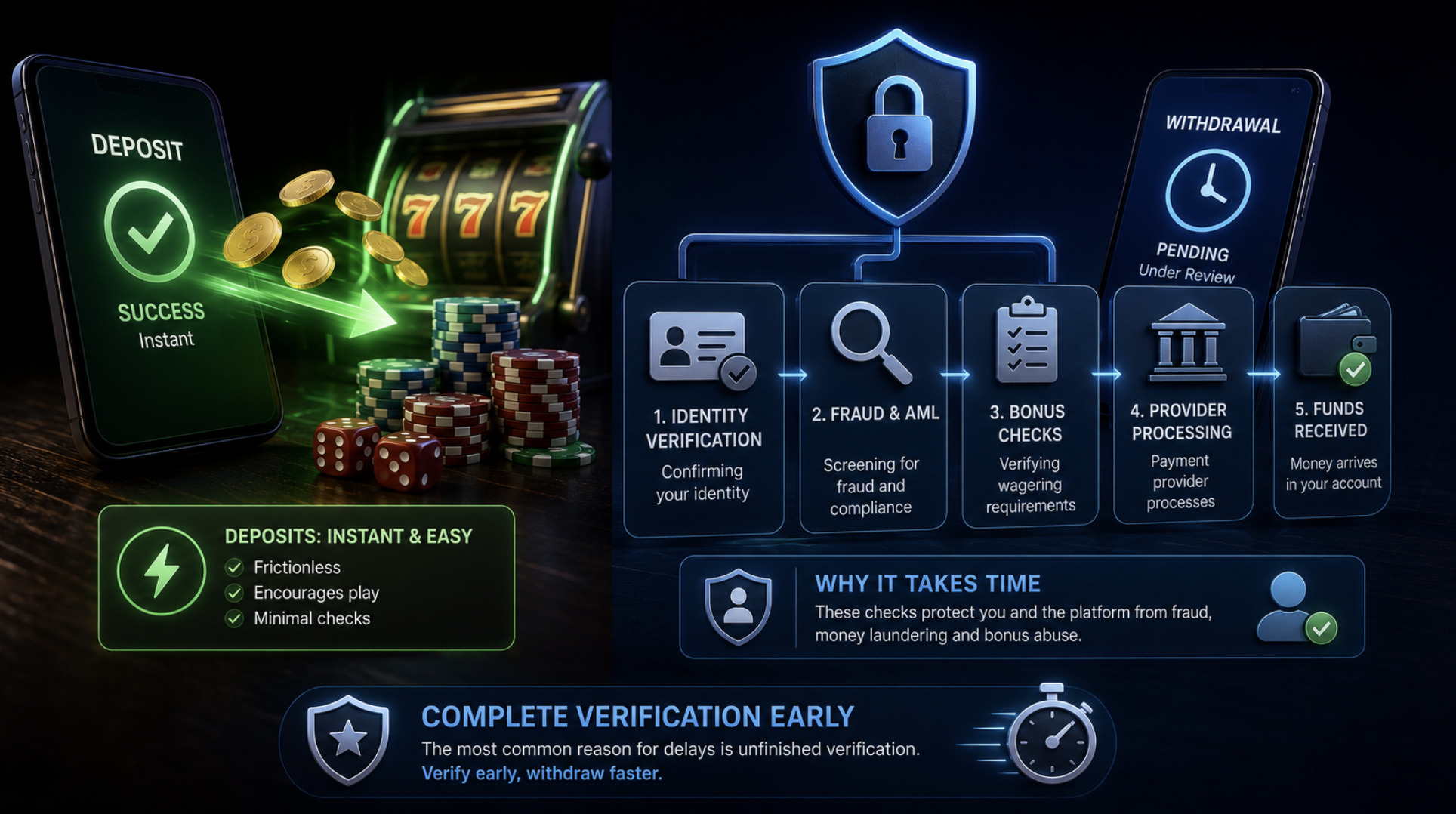
There is a peculiar asymmetry that every online casino player eventually notices. Depositing money is instant, effortless and encouraged. Withdrawing it involves a wait, sometimes a verification request, occasionally a limit nobody mentioned, and a "pending" status that seems designed to test your patience. It is easy to read this as an operator dragging its feet on purpose. The reality is more structured and, once understood, far less frustrating: a withdrawal passes through a defined sequence of stages, each of which exists for a reason, and much of the total waiting time is determined by choices the player controls. This guide breaks the process down stage by stage, method by method, so you know exactly what to expect and how to speed it up.
The three stages of every withdrawal
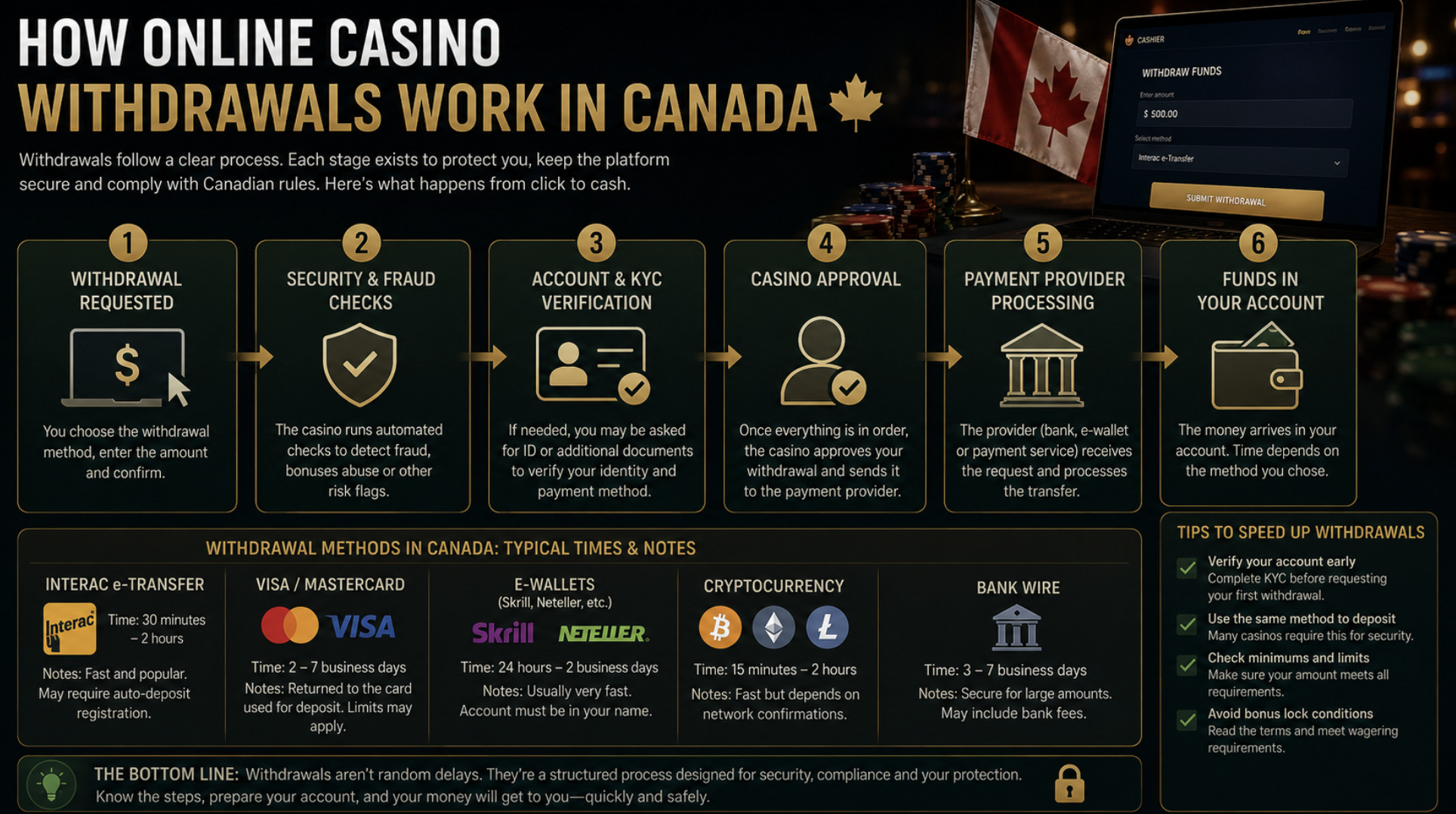
Whatever casino you use and whatever method you pick, a withdrawal travels through the same three stages:
The request. You go to the cashier, choose an amount and a payout method, and submit. At this point the money leaves your playable balance and enters the withdrawal process.
Processing (the "pending" period). The operator reviews and approves the request internally. This is entirely separate from your bank and is where the operator's own checks happen.
The transfer. Once approved, the funds are sent by your chosen method, and the payment provider or bank then adds its own processing time before the money actually lands.
Your total wait is simply the operator's processing time plus the payment method's transfer time. This is why two players at the same casino, withdrawing on the same day, can wait wildly different amounts — they chose different methods, and the second stage's clock runs at a different speed for each.
Why withdrawals are slower than deposits
The gap between instant deposits and slower withdrawals is deliberate, and mostly justified. Deposits are frictionless because the operator wants you playing quickly and there is little to check when money is coming in. Withdrawals, by contrast, trigger a set of checks that deposits never do: confirming your identity, screening the transaction for fraud and anti-money-laundering compliance, and verifying that any bonus conditions tied to the balance have been satisfied. These steps protect both you and the platform, and they take time. Far and away the most common cause of a slow first withdrawal is unfinished identity verification, which is why regulated operators — platforms such as casoola.ca among them — nudge players to complete verification early rather than at the moment of cashing out.
How the method decides your timeline
Once the operator approves your withdrawal, the method you chose determines almost everything about how fast the money arrives. Here is how the common options compare:
MethodTypical speed after approvalNotesE-walletsOften within hoursUsually the fastest option; money moves digitally and quicklyCryptocurrencyOften within hoursFast by nature, where supported and understoodDebit/credit cardA few business daysRuns on banking rails; slower than walletsBank transferA few business daysDirect and trusted, but settles on business days only
The pattern is clear: digital methods lead on speed, while card and bank methods trail because they depend on traditional banking systems. This is exactly why a single casino can honestly advertise both "fast" and "slow" payouts — the operator's part may be quick, but the method sets the rest of the clock. Choosing a faster method, where it suits you, is the most direct lever you have on the total wait.
Two worked timelines
Consider two Canadian players, each with a $500 withdrawal approved on a Friday afternoon.
The first chose an e-wallet. After the operator's processing completes, the funds reach the wallet within a few hours, and the player has their money the same evening.
The second chose a bank transfer. The operator processes it just as quickly, but because banks settle only on business days, the transfer does not begin moving until Monday and lands a day or two later, early the following week.
Same casino, same amount, same approval time — yet one player is paid on Friday night and the other midway through the next week. Nothing unfair happened. The difference is entirely the method and the intervening weekend. Understanding this "weekend effect" on its own removes a great deal of needless anxiety about a withdrawal that seems stuck.
The pending period, and the trap inside it
The stage players understand least is the pending or "reversal" window. During this period, your withdrawal has been requested but not yet sent, and many platforms let you cancel it and return the money to your playable balance. It exists partly for the operator's review and partly as a convenience, but it hides a genuine trap: a player who cancels a pending withdrawal to squeeze in "just a few more spins" can end up gambling away the very money they were about to bank. The discipline here is simple. Request your withdrawal, then leave it alone. Let the pending period run its course rather than reversing it on impulse. Some operators even offer a lock or "flush" feature that removes the reversal option precisely to protect players from this temptation — if yours does, and you know the temptation is real for you, use it.
Limits, large wins and instalments
Withdrawals are also shaped by limits that vary by operator and are laid out in the terms: a minimum you can withdraw, and daily, weekly or monthly maximums. These rarely trouble everyday players, but they matter after a big win. If a payout exceeds a periodic cap, it may be released in instalments rather than a single lump sum — a large jackpot, for instance, might arrive in weekly tranches. Players who expect one grand transfer can be surprised. For Canadians, dealing with licensed, regulated operators matters here too, because regulated platforms are held to clearer standards on honouring withdrawals and disclosing their limits up front. The remedy for surprises is unglamorous but reliable: read the withdrawal terms before you deposit, not after you win.
How bonuses can hold a withdrawal
If you have claimed a bonus, it can directly affect whether a withdrawal goes through. Bonus funds almost always carry wagering requirements — a fixed multiple of the bonus (and sometimes the deposit) that you must wager before the bonus and any winnings from it can be withdrawn. Try to cash out before meeting them, and the request may be blocked or the bonus and its winnings forfeited. This is not the casino unfairly withholding your money; it is the published condition you accepted when you took the bonus. Anyone playing with a bonus should know its wagering requirement and confirm it has been met before requesting a withdrawal. It is one of the most common reasons a withdrawal "won't work," and it is entirely avoidable with a glance at the terms.
A checklist for getting paid faster
Pulling it together, several habits shorten the wait to only the parts that are genuinely unavoidable:
Verify your identity early, right after signing up.
Choose a fast method such as an e-wallet where it suits you.
Meet any bonus wagering requirements before requesting a withdrawal.
Time bank-based withdrawals with the working week in mind to dodge the weekend delay.
Don't cancel a withdrawal once you have requested it.
Do these five things and you strip out every delay within your control, leaving only the minimum processing time the system genuinely needs.
Reasons a withdrawal can be delayed or declined
When a withdrawal takes longer than expected or is turned back, the cause is almost always one of a familiar handful of issues rather than anything sinister:
Incomplete identity verification. The classic culprit for a slow first withdrawal; the operator cannot release funds until KYC is done.
Unmet bonus wagering requirements. If bonus funds are involved and the wagering is not complete, the withdrawal can be blocked or the bonus forfeited.
A mismatch between deposit and withdrawal methods. Some methods that accept deposits cannot process withdrawals, forcing you onto an alternative.
Exceeding a withdrawal limit. Amounts above a daily, weekly or monthly cap may be split into instalments rather than paid at once.
A pending review or additional documentation request. Larger sums can trigger extra anti-money-laundering checks, including source-of-funds questions.
Each of these has a straightforward resolution — finish verification, meet the wagering, choose a compatible method, or provide the requested document — and none reflects an operator acting in bad faith. Reading the cashier and terms in advance heads off nearly all of them.
A note on gambling winnings and tax in Canada
A question that naturally follows any discussion of withdrawals is whether the money is taxed. In Canada, gambling winnings for recreational players are generally treated as a windfall rather than as taxable income, which means casual players typically do not pay tax on their winnings. The picture can differ for someone who gambles in a professional, business-like manner, where different tax considerations may apply. This is a general overview and not tax advice — individual circumstances vary, and anyone with a specific question about their own situation should consult a qualified tax professional or the Canada Revenue Agency. The point worth taking away is simply that, for the ordinary recreational player in Canada, the amount that lands in your account after a withdrawal is usually the amount you keep.
Planning your first withdrawal
Putting all of this together, the smoothest path to a first payout is easy to map out in advance. As soon as you open an account, complete identity verification, before you have any winnings waiting — this single step removes the most common source of delay. Choose a payment method that supports both deposits and withdrawals, ideally a fast one such as an e-wallet if quick access matters to you, so you are not forced onto a slower alternative when it is time to cash out. If you are playing with a bonus, keep track of the wagering requirement and confirm it is fully met before you request a withdrawal.
When you do request the payout, note the day of the week if you are using a bank-based method, since a request made before the weekend on a slower method will not begin moving until the next business day. Then, once submitted, leave it alone and let the pending period run rather than cancelling on impulse. Follow this sequence and the process behaves predictably: a short internal review, then the transfer time for your chosen method, and the money arrives without drama. Most withdrawal frustrations come from skipping one of these steps and being surprised by the consequence — so a little planning at the start turns cashing out from a source of anxiety into a routine, expected part of playing.
Frequently asked questions
Why do casino withdrawals take so long? Because they include checks deposits skip — identity verification, fraud and anti-money-laundering review, and bonus-condition checks — plus the payment method's own transfer time. Unfinished verification is the most common cause of a slow first payout.
What is the fastest way to withdraw? E-wallets and cryptocurrency are usually fastest, often within hours. Cards and bank transfers typically take a few business days because they use traditional banking systems.
Can I cancel a withdrawal while it's pending? Often yes — but the money returns to your balance, where it can be gambled away. It is best to leave a requested withdrawal to process.
Why was my withdrawal blocked after I used a bonus? Bonus funds carry wagering requirements you must meet first. If they are unmet, the withdrawal can be blocked or the bonus forfeited. Check the requirement before cashing out.
Do withdrawals process over the weekend? The operator's review can happen any day, but bank-based methods settle only on business days, so a transfer requested on a weekend often will not move until the next business day.