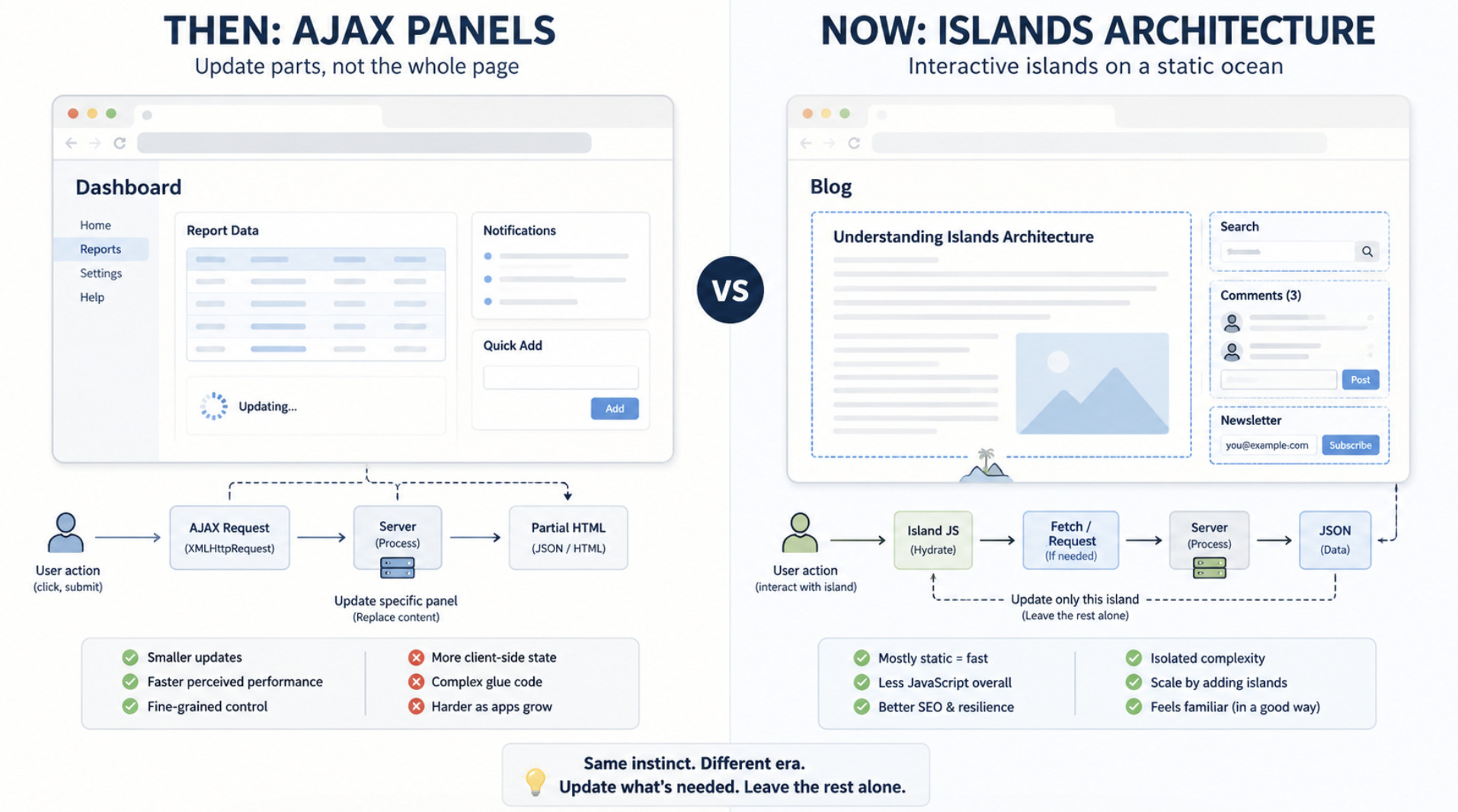
For anyone who has watched web development long enough, the newest fashionable idea often carries a familiar echo. Islands architecture is one of those ideas. It proposes that a web page should be mostly static HTML, with only small, isolated regions of interactivity — the "islands" — running JavaScript, each one activated independently. To a developer raised on single-page applications, this can sound like a radical rethink. To anyone who remembers the era this publication was built in, it sounds a great deal like the old instinct behind AJAX panels: update the part of the page that needs to change, and leave the rest alone. The idea has come back around, and it is worth understanding both on its own terms and as the latest turn in a very long conversation about how much JavaScript the web really needs.
The problem islands architecture solves
To understand why islands architecture emerged, you have to understand the problem it reacts against. Over the past decade, the single-page application became the default way to build ambitious web interfaces. In that model, the browser downloads a large bundle of JavaScript, and that JavaScript takes over, rendering the entire page and handling every interaction on the client. It is a powerful approach, and for genuinely application-like experiences it works well. But it came with a cost that grew heavier as sites scaled: the browser had to download, parse and execute enormous amounts of JavaScript before the page became usable, even when most of the page was static content that never needed to be interactive at all.
This is the waste islands architecture targets. Consider a typical content page — an article, a product listing, a blog post. The overwhelming majority of it is static: text, images, headings, links, none of which require any client-side JavaScript to display. Only a few elements are truly interactive: a search box, a menu, a comment form, a small widget. The single-page model treats the whole page as an application and ships JavaScript to match, even though almost none of it needs interactivity. Islands architecture asks the obvious question that the SPA era had stopped asking: why send interactive machinery for the parts of the page that are just content? It is the same question, at heart, that the AJAX era answered in its own way, and that the recent server-rendering revival has been re-answering, as covered in the server-side rendering comeback that reshaped the web.
How the pattern actually works
The mechanics of islands architecture are elegant precisely because they are conservative. The page is rendered to HTML on the server and sent to the browser as mostly static markup, which means it displays quickly and works even before any JavaScript has run. Within that static page sit the islands: the specific components that genuinely need interactivity. Each island is a self-contained piece of client-side functionality, and crucially, each one is hydrated — brought to life with its JavaScript — independently of the others. The static ocean around them ships no interactivity at all.
This selective, independent hydration is the whole trick. Rather than shipping one giant bundle that takes over the entire page, the browser only loads and runs the JavaScript for the interactive islands, and it can do so on its own schedule — hydrating an island when it becomes visible, or when the user interacts with it, rather than all at once on load. The result is a page that arrives fast as static HTML and then progressively activates only where activation is needed. A search widget becomes interactive; the article around it never needed to be. Frameworks built around this idea, most notably Astro, have made the pattern practical and popular, and the appeal is easy to state: dramatically less JavaScript shipped, for the same visible result.
Why this echoes the AJAX era
For readers of this archive, the resonance is impossible to miss. The founding insight of the AJAX era was that you did not need to reload and rebuild the entire page to change one part of it; you could update just the region that mattered and leave everything else untouched. The old AJAX panels embodied exactly this — a mostly static page with specific zones that could refresh on their own. Islands architecture applies a strikingly similar philosophy to interactivity itself: a mostly static page with specific zones that carry their own client-side behaviour, independent of the whole. The technology and the vocabulary are new; the underlying instinct is old and familiar.
This is not a coincidence so much as a rediscovery. The web has spent twenty years oscillating between two poles — the server sending finished HTML, and the client doing more and more of the work — and the pendulum has swung back toward the middle, where the server does most of the rendering and the client handles only the genuinely interactive bits. Anyone who lived through the shift from full page reloads to partial updates, and then watched the industry move on to the whole-page-as-application model, is entitled to a wry smile at the return of "just update the parts that need it." The lineage runs straight through the AJAX story we traced in how AJAX evolved from XMLHttpRequest to the modern Fetch API. Islands architecture is, in a real sense, the same conversation continued with better tools.
Where islands fit, and where they do not
Like every architecture, islands are a set of trade-offs rather than a universal answer, and using them well means knowing where they shine. They are ideal for content-heavy sites: blogs, documentation, marketing pages, publications, storefronts — anywhere the page is mostly static content with pockets of interactivity. For these, islands architecture delivers fast-loading, resilient pages that ship a fraction of the JavaScript a single-page application would, which is better for performance, for users on slow connections and modest devices, and often for search visibility, since the content arrives as real HTML. This is a large and important part of the web, and for it the pattern is close to ideal.
Where islands fit less naturally is the genuinely application-like experience: a rich, highly interactive interface where almost everything on screen is stateful and dynamic — a complex dashboard, a design tool, a live editor. When most of the page really is an application, the static-with-islands model offers less advantage, because there is little static ocean to leave alone; the single-page approach may still be the better fit there. The skill, as always, is matching the architecture to the actual shape of what you are building rather than following fashion in either direction. Islands are not the end of single-page applications; they are a reminder that most of the web is not an application and never needed to be treated as one.
An old idea, usefully rediscovered
The rise of islands architecture is a healthy correction. After a decade in which the industry's default answer to almost every web problem was "ship more JavaScript and render it on the client," a pattern has taken hold that starts from the opposite instinct: send finished HTML, ship JavaScript only where it earns its place, and hydrate those places independently. The result is faster, leaner, more robust pages for the enormous category of sites that are mostly content, and a welcome loosening of the assumption that everything must be a single-page application.
For those of us who remember when partial page updates were the exciting new idea, there is a particular satisfaction in watching the web rediscover, with fresh vocabulary and better frameworks, that you do not have to rebuild the whole page to change part of it, and you do not have to make the whole page an application to make part of it interactive. The tools are new, the performance is better, and the developer experience has come a long way. But the core wisdom is the same one this publication was founded on: figure out which part actually needs to change, and leave the rest alone. Islands architecture is that wisdom, sailing back into view under a new name.