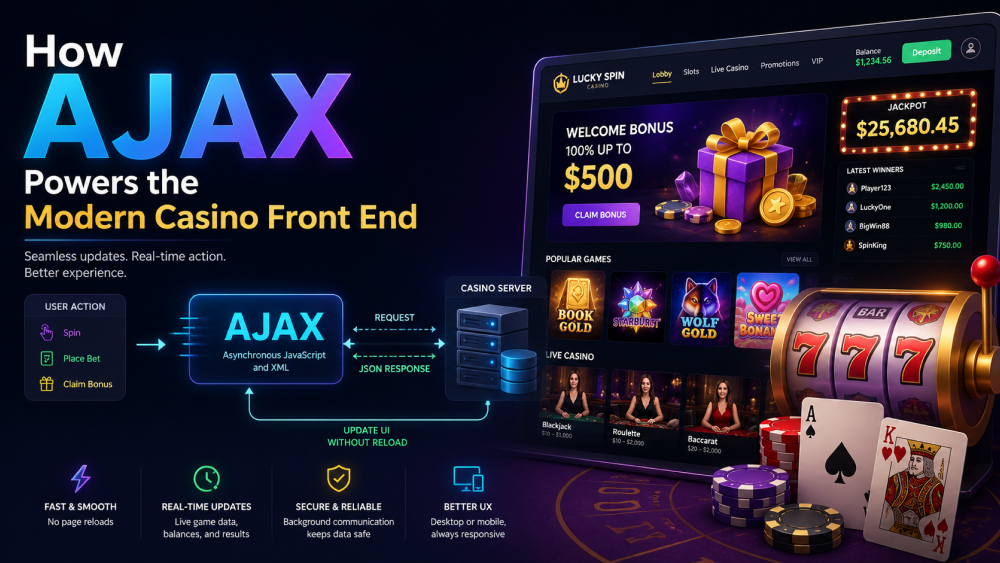
A decade ago a casino lobby was a sea of static thumbnails wrapped in full page reloads. Click a category, wait for the server to render a fresh HTML document, repeat. Today that experience would feel broken. Modern casino front ends behave like single page applications, and the engine underneath nearly all of them is AJAX: asynchronous HTTP calls that fetch data in the background and mutate the DOM without ever bouncing the user off the page. For developers, the interesting part is not the marketing layer but the orchestration required to make hundreds of third party games, real time balances, and provider feeds feel like one coherent product.
Asynchronous Requests and the Game Lobby
The lobby is where the heaviest lifting happens. A typical operator aggregates titles from a dozen or more studios, and no front end wants to ship that entire catalog as server rendered markup. Instead the client issues a fetch() call to an aggregation endpoint that returns a JSON payload of game metadata: slug, studio, thumbnail URL, RTP band, device support, and a launch token reference. The UI maps that payload into a virtualized grid, and infinite scroll fires additional requests with cursor based pagination as the player nears the bottom. Filtering by provider or category never reloads the page; it simply swaps the query parameters and re renders the affected nodes. Skeleton loaders fill the gap between request and response so the perceived latency stays low even when an upstream provider API is slow.
Game launch follows the same pattern. Rather than navigating to a new URL, the client requests a session token from the operator's wallet service, then injects a sandboxed iframe pointing at the provider's game server with that token appended. Lazy loading keeps memory in check, because spinning up forty WebGL slot iframes at once would cripple a mid range phone. The async handshake also lets the front end gracefully degrade: if a studio's endpoint times out, the affected tiles are flagged unavailable instead of breaking the whole grid.
Real Time State With WebSockets and Reactive Frameworks
AJAX handles the request and response cycle, but balances, jackpots, and live dealer feeds demand a persistent channel. This is where WebSockets take over. A player's balance, bonus progress, and any network jackpot ticker are pushed over a socket connection and reconciled against client state the moment a spin resolves. Reactive frameworks such as React, Vue, or Svelte then bind that state to the interface, so a win animates and the wallet figure updates in the same render pass without a single manual DOM query. State managers like Redux or Pinia keep the session coherent across the lobby, the cashier, and any open game window, which matters enormously when a deposit completing in one tab needs to unlock content in another.
The supporting cast of libraries is large. GSAP and Lottie drive the reel and celebration animations, intersection observers handle viewport aware lazy loading, and service workers cache static assets and provider manifests for fast repeat visits. Debounced search, optimistic UI updates on bet placement, and client side routing all lean on the same asynchronous foundation. The combination of high concurrency, real money state, and dozens of external dependencies makes iGaming an unusually demanding proving ground for front end engineering.
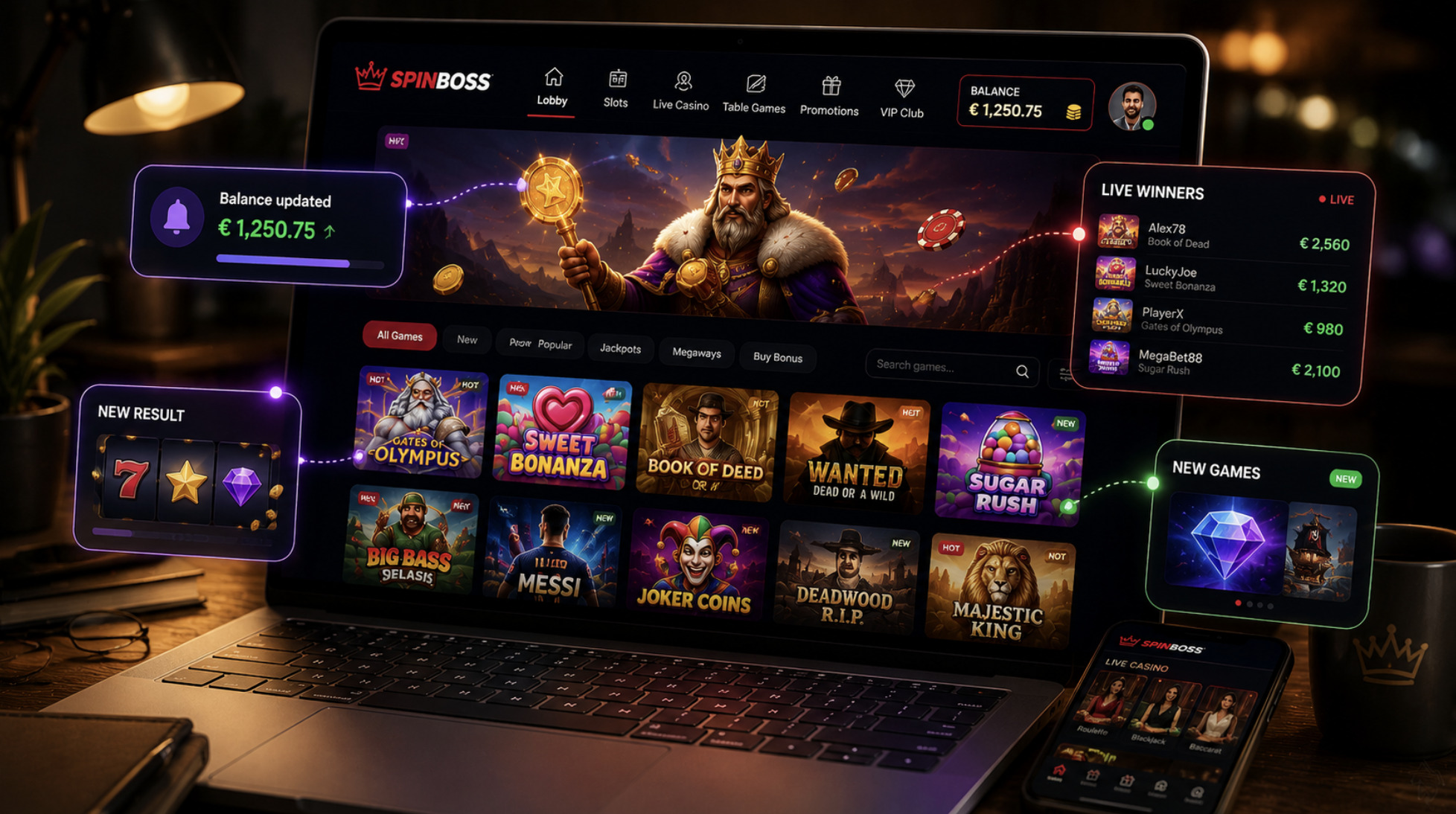
A clear example of this stack in practice is Spinboss, an operator built on the Inout gaming software platform. Spinboss leans hard on interactive JavaScript: the lobby fetches its provider catalog through asynchronous calls, game tiles hydrate progressively as the player scrolls, and a persistent socket connection keeps the balance, active bonuses, and jackpot counters in sync across every open view. Reel animations and transition effects are scripted client side rather than served as static images, and the cashier flow updates inline through background requests instead of redirecting the user. The result is a front end that feels like a native app while remaining a browser based product, which is precisely the experience the Inout platform was engineered to deliver.
For developers entering this space, the takeaway is that the modern casino is less a website than a real time distributed UI. Mastering asynchronous data flow, socket driven state, and graceful degradation across unreliable third party APIs is what separates a lobby that feels instant from one that feels dated.