It is easy to forget how radical AJAX once felt. For much of the early web, every interaction meant a full page reload: click a link, submit a form, and the browser would blank out and fetch an entirely new document from the server. The arrival of asynchronous JavaScript and XML, the technique we came to call AJAX, broke that cycle. Suddenly a page could talk to the server quietly in the background and update only the part that had changed, and the web began to feel less like a stack of documents and more like an application. The journey from that breakthrough to today's seamless interfaces is a story of steadily better tools built on one enduring idea.
The XMLHttpRequest Era
The engine behind the original revolution was an unassuming browser object called XMLHttpRequest. Despite the name, it was never limited to XML, and in time most developers used it to exchange JSON instead. What it offered was the ability to issue an HTTP request from JavaScript and handle the response without leaving the page. The catch was that working with it directly was verbose and awkward, built around callbacks and a numeric ready-state that you had to inspect by hand:
javascript
var xhr = new XMLHttpRequest();
xhr.open('GET', '/api/products');
xhr.onreadystatechange = function () {
  if (xhr.readyState === 4 && xhr.status === 200) {
    var data = JSON.parse(xhr.responseText);
    render(data);
  }
};
xhr.send();
The pattern worked, and it powered a generation of more responsive websites, but it was fiddly and error-prone. Handling failures, parsing responses, and coordinating several requests at once required careful boilerplate that was easy to get wrong.
Libraries Smoothed the Edges
Because the raw API was so unfriendly, libraries quickly rose to hide its complexity. The most influential of these wrapped XMLHttpRequest in a far more pleasant interface, letting developers describe a request in a single readable call and attach handlers for success and failure. This abstraction did more than save keystrokes. It standardised behaviour across browsers that implemented the underlying object inconsistently, and it popularised conventions, such as defaulting to JSON, that still shape how we build web applications. For years, a concise helper for asynchronous requests was one of the first things any front-end project reached for, and it taught a whole community to think in terms of asynchronous data rather than full-page navigation. These libraries also pioneered patterns that outlived them, such as treating a request as a configurable object, normalising error handling into a single place, and exposing hooks that ran before and after every call. Much of what we now consider obvious about talking to a server was first worked out in these wrappers, and the conventions they established quietly became the expectations that native browser APIs would later have to meet.
The Fetch API and Promises
The modern era began when the browser itself adopted a cleaner native approach in the form of the Fetch API. Built around promises rather than callbacks, fetch replaced the tangle of ready-state checks with a flat, composable flow that reads almost like a description of intent:
javascript
fetch('/api/products')
  .then(response => response.json())
  .then(data => render(data))
  .catch(error => console.error(error));
Promises mattered because they gave asynchronous code a consistent shape. Instead of nesting callbacks ever deeper, developers could chain operations in sequence and handle errors in one place. The Fetch API also embraced the realities of HTTP more honestly, treating requests and responses as first-class objects you could inspect and reuse. It was not perfect, and its decision not to reject on HTTP error statuses still surprises newcomers, but it represented a decisive step toward treating network access as a native, ergonomic part of the language.
Async and Await
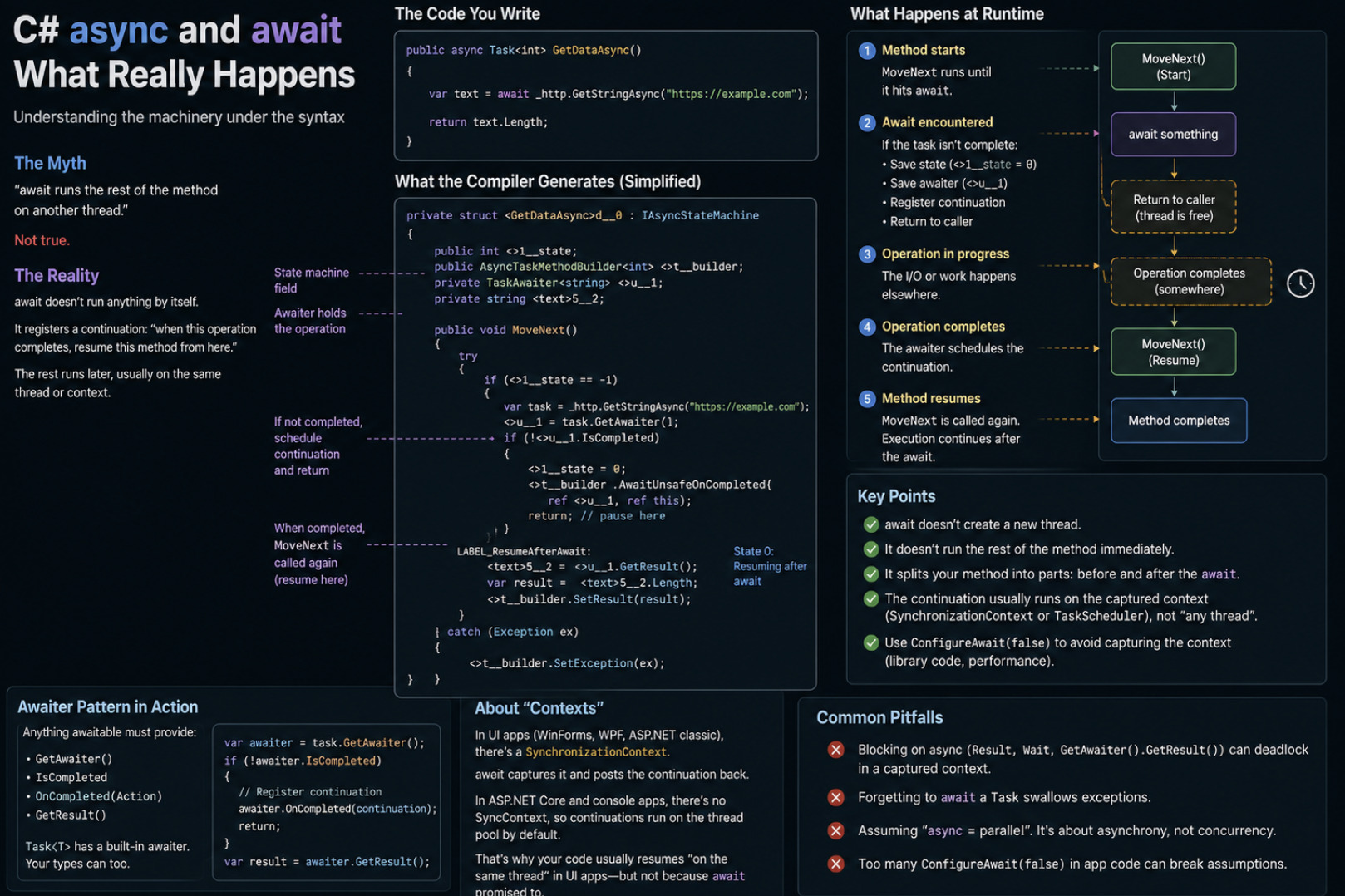
The final piece of the modern picture is the async and await syntax, which lets developers write asynchronous code that looks and reads like ordinary synchronous code while remaining non-blocking underneath:
javascript
async function loadProducts() {
  try {
    const response = await fetch('/api/products');
    if (!response.ok) throw new Error(`Request failed: ${response.status}`);
    const data = await response.json();
    render(data);
  } catch (error) {
    console.error(error);
  }
}
This is the same operation that once required a dozen lines of XMLHttpRequest ceremony, now expressed with clarity and a natural error-handling structure. The flow is obvious at a glance, exceptions propagate through familiar try and catch blocks, and the cognitive load of asynchronous programming drops dramatically. For most developers today, this is simply how data fetching is done.
The Idea That Endured
What is striking across this whole evolution is how little the central concept has changed even as the tools were transformed beyond recognition. The premise that the original technique introduced, that a page can communicate with the server in the background and update itself without a full reload, is precisely the premise on which every modern single-page application rests. Frameworks now manage components, state, and rendering on top of this foundation, but underneath their sophisticated machinery they are still issuing asynchronous requests and weaving the responses into the page, exactly as the earliest AJAX experiments did.
The lineage is worth remembering because it offers perspective. Each generation of tooling, from the raw browser object to helper libraries to the Fetch API and async syntax, solved real pain points of the one before it while preserving the breakthrough at the heart of the approach. Understanding that history is not mere nostalgia. It helps developers grasp why modern APIs are shaped the way they are, appreciate the problems they quietly solve, and recognise that today's elegant await fetch is the direct descendant of a clunky object that, two decades ago, quietly changed what the web could be.