For nearly two decades, building a web endpoint in .NET meant the same ritual: a controller class, a base class to inherit, attributes to decorate, and a small mountain of ceremony wrapped around what was often three lines of actual logic. Minimal APIs changed that. Introduced to let developers define an HTTP endpoint in a handful of lines with no controller in sight, they have quietly become one of the most consequential shifts in how modern .NET applications are structured. For a site that spends its time tracing how web development patterns rise, fall and return, minimal APIs are a story worth telling properly — because they are both a genuine simplification and a decision with real trade-offs.
What a minimal API actually is
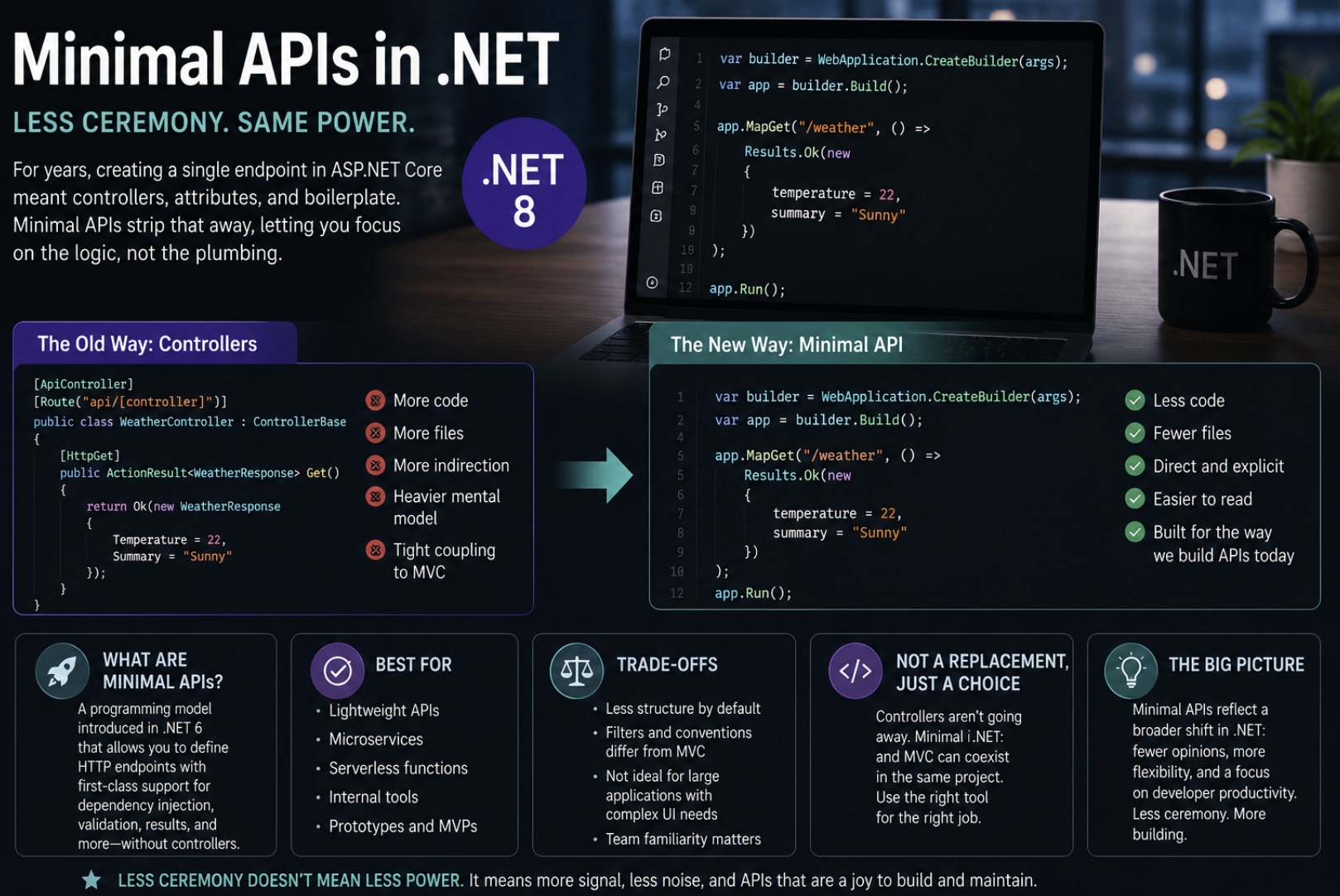
A minimal API is exactly what the name promises: the smallest possible way to declare an HTTP endpoint. Instead of creating a controller class and a method decorated with routing attributes, you map a route directly to a function, often a lambda, right where the application is configured:
csharp
var app = builder.Build();

app.MapGet("/products/{id}", (int id, ProductService svc) =>
    svc.Find(id) is Product p ? Results.Ok(p) : Results.NotFound());

app.Run();
That single MapGet line is a complete, working endpoint. It declares the route, binds the id from the URL, has the ProductService injected automatically, and returns an appropriate HTTP result. There is no controller, no base class, no separate file — the endpoint lives as close as possible to the thing that runs it. For small services, the entire application can fit in one readable file.
Why they caught on
The appeal of minimal APIs is not merely that they are shorter, though the reduction in boilerplate is real and welcome. The deeper reason they resonated is that they remove a layer of indirection that, for many services, was pure overhead. In the controller model, understanding an endpoint often meant jumping between the route attribute, the method, the base class and the framework's conventions to work out what actually happened. A minimal API puts the route, the inputs and the logic in one place you can read top to bottom.
This fits a broader mood in the industry: a fatigue with ceremony and a renewed appreciation for shipping less code to do the same job. Minimal APIs also carry a performance benefit, because they avoid some of the machinery the full controller pipeline sets up. For the enormous number of services that are really just a thin layer of HTTP over some business logic — microservices, internal tools, small backends — the controller was always heavier than the task required, and minimal APIs finally offered an officially supported alternative. It is the same instinct toward less overhead that drove the wider server-side rendering comeback.
Where minimal APIs shine
Minimal APIs are at their best when the service is small, focused, and does not need the organisational scaffolding that controllers provide. A microservice exposing a handful of endpoints is close to an ideal case: the whole thing is comprehensible at a glance, there is nothing to navigate, and the mapping from URL to behaviour could not be more direct. The same is true of prototypes and internal utilities, where the goal is to get a working endpoint in front of someone quickly without setting up a project structure that outweighs the code.
They also pair naturally with the modern, cloud-oriented style of building software, where applications are decomposed into many small deployable units rather than one large one. When each service is small by design, the controller's apparatus for organising dozens of related endpoints is solving a problem the service does not have. In that setting, minimal APIs are not a shortcut but the honestly correct tool — the amount of structure matches the amount of code.
When the controller still wins
It would be a mistake, though, to read minimal APIs as the controller's obituary in every case. As an application grows, the very ceremony that felt like overhead in a small service starts to earn its keep. Controllers give you a natural place to group related endpoints, share behaviour across them through conventions and filters, and keep a large surface area organised into coherent units. A sprawling application built entirely from loose Map calls can become just as hard to navigate as an over-engineered one — the structure has to live somewhere.
The honest guidance is therefore about fit rather than fashion. For small, focused services, minimal APIs remove real friction and should probably be the default. For large applications with many endpoints, cross-cutting concerns and teams that benefit from strong conventions, controllers still offer organisation that is genuinely useful, and reaching for minimal APIs there can trade a little early convenience for later disorder. Modern .NET supports both precisely because both are right, for different sizes of problem — and choosing well is part of the same discipline we described in modernizing legacy .NET applications without a full rewrite.
An old lesson in new syntax
There is something familiar in all of this for anyone who has watched web frameworks evolve. The industry swings between elaborate structure and lean directness, and minimal APIs are the current expression of the lean swing — a reaction to years of accumulating ceremony, offering the shortest path from a URL to a response. Like every such swing, it is a genuine improvement for the cases it fits and a temptation to misuse where more structure is warranted.
The quiet death of the controller, then, is not really a death at all. It is the arrival of a second, lighter option, and the end of the assumption that every endpoint must be wrapped in a class whether it needs one or not. The best .NET developers will not pick a side; they will pick the tool that matches the size of the service in front of them, reaching for minimal APIs when the job is small and for controllers when the job has grown large enough to need them. That judgement, more than the syntax, is what the shift actually asks of us.
Frequently asked questions
What is a minimal API in .NET? A minimal API is the simplest way to define an HTTP endpoint in .NET, mapping a route directly to a function without a controller class, base class or routing attributes. The route, its inputs and its logic all live in one place, often a single lambda, making small services concise and easy to read.
Are minimal APIs better than controllers? Neither is universally better. Minimal APIs remove boilerplate and suit small, focused services and microservices. Controllers provide organisation, shared behaviour and conventions that become valuable as an application grows large. The right choice depends on the size and complexity of the service.
When should I not use minimal APIs? Avoid them as the sole approach for large applications with many endpoints and significant cross-cutting concerns, where the organisation controllers provide genuinely helps. A big application built entirely from loose route mappings can become as hard to maintain as an over-structured one.