Few features in C# are used as widely, or understood as shallowly, as async and await. Almost every modern .NET codebase is threaded through with them, and most developers can write an async method that works. Yet ask what actually happens when you await something, and the answers get vague fast — usually some hand-waving about "running on another thread" that is not quite right and leads directly to the bugs that plague async code. The truth is more elegant and more useful than the folklore. Understanding what the compiler really does with async and await, and why await does not do what most people think, is the difference between using the feature and being caught out by it. This is a look under the hood, aimed at the developer who wants to stop guessing.
The problem async was built to solve
To understand async and await, start with the problem they exist to fix, because the design only makes sense in that light. Much of what a program does is not computation but waiting — waiting for a database to answer, a web request to return, a file to be read from disk. These operations take time, and during that time the processor has nothing to do for that particular piece of work. In the old synchronous model, the thread running the code would simply sit and block, doing nothing, until the operation completed. On a server handling many requests, this is ruinously wasteful: threads are a limited, expensive resource, and having them stand idle waiting on I/O means the application can serve far fewer users than the hardware should allow.
Asynchronous programming solves this by letting a thread do other useful work instead of blocking during a wait. The idea is that when your code reaches an operation that will take time, it can release the thread to go handle something else, and only pick the work back up once the operation has finished. This is enormously valuable for scalability, but historically it was painful to write, requiring convoluted callbacks and manual state management that turned straightforward logic into a tangled mess. The genius of async and await is that they give you all the scalability benefits of this non-blocking model while letting you write code that reads almost exactly like ordinary sequential code. The complexity did not vanish; it moved into the compiler.
What the compiler actually does
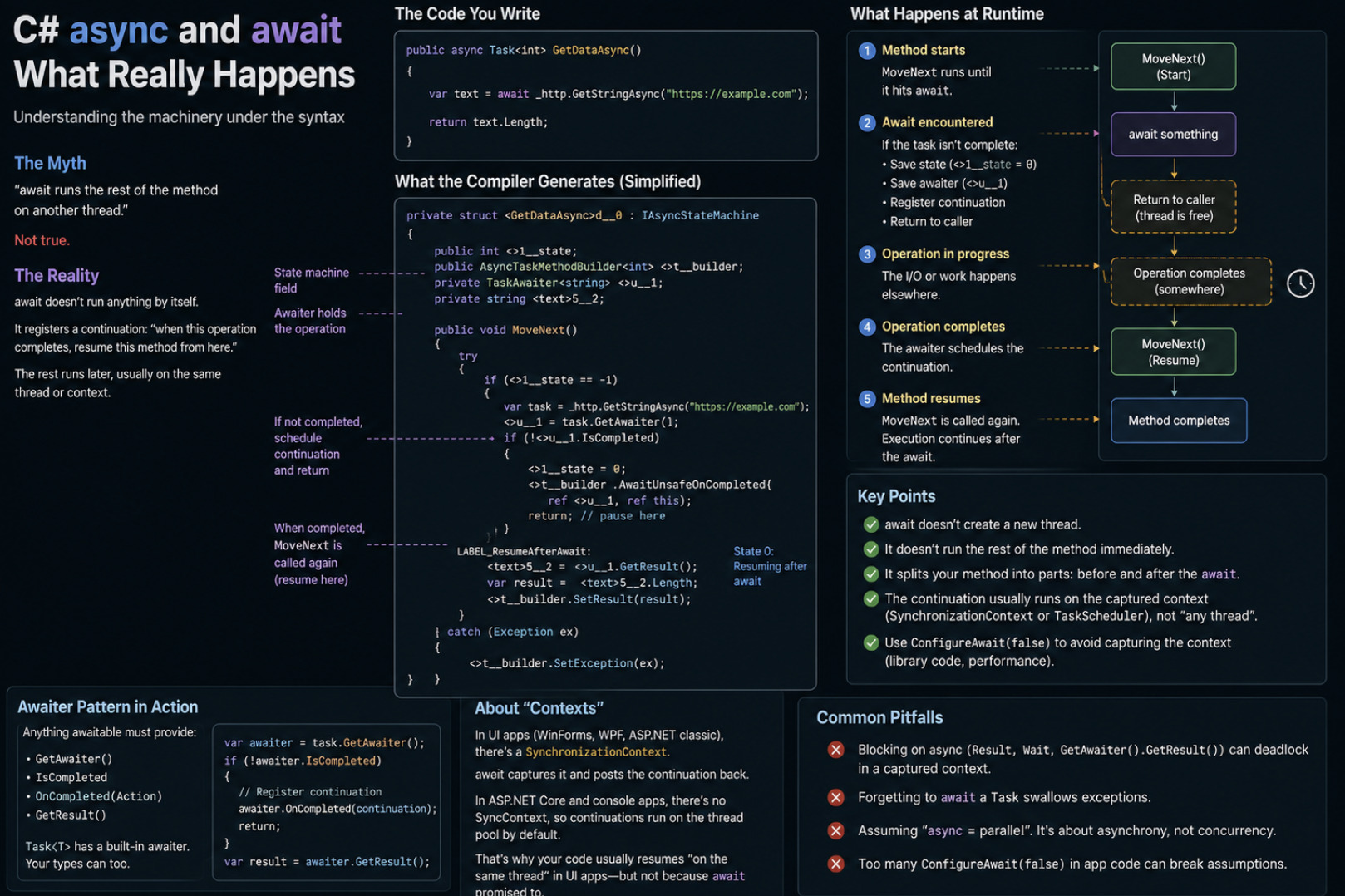
Here is the part that dispels most of the confusion: async and await are, to a large degree, a compiler transformation. When you mark a method async and use await inside it, the C# compiler does not run your method as one straight-through sequence. Instead, it rewrites your method into a state machine — a structure that can pause at each await point and resume later exactly where it left off. Your neat, linear-looking method is quietly turned into an object that remembers its position, so that it can stop at a wait, hand control back, and continue from precisely that spot once the awaited work is done.
This is why async code can look sequential while behaving asynchronously. Each await marks a point where the method might pause: the compiler-generated state machine checks whether the awaited operation has already completed, and if it has not, it saves its place and returns control to the caller, arranging to resume when the operation finishes. When you write what looks like ordinary top-to-bottom code, you are really describing the states of a machine that the compiler builds for you. Understanding that await is a suspension point, and that the method is a resumable state machine rather than a continuous run of instructions, is the single most clarifying idea in the whole subject. Once you see it, the behaviour of async code stops being mysterious.
Why await does not mean "another thread"
Now to the misconception that causes the most trouble. Many developers believe that awaiting something runs it on a background thread — that async is a form of multithreading. This is not what await does, and the confusion is the source of countless bugs. Awaiting an operation does not, by itself, start a new thread or move work onto one. What it does is release the current thread while the operation is in progress, so that thread is free to do other work, and then arrange for your method to continue once the operation completes. For genuinely asynchronous I/O — a network call, a database query — there is often no thread doing the waiting at all; the waiting is handled by the operating system, and no thread is consumed while it happens.
This distinction matters enormously in practice. Asynchronous is not the same as parallel. async and await are primarily about not wasting threads during waits, especially waits on I/O, rather than about running many computations at once. Blurring the two leads to the classic mistakes: assuming await gives you concurrency it does not, or reaching for async to speed up work that is purely CPU-bound, where it offers little and a different tool is appropriate. The reason this model scales so well on servers is precisely that it lets a small number of threads serve a large number of waiting operations, because those threads are not stuck blocking — which is the same underlying concern that makes non-blocking, event-driven updates so valuable on the front end, a lineage traced in how AJAX evolved from XMLHttpRequest to the modern Fetch API.
The pitfalls that catch people out
Because async and await hide real complexity behind simple syntax, they come with a set of well-known traps, and knowing them separates robust code from fragile code. The most notorious is mixing synchronous and asynchronous code by blocking on an async call — calling something that waits synchronously for an async operation to finish, often by grabbing its result directly. In certain contexts this can cause a deadlock, where the code waits for an operation that cannot complete because the very thread it needs is the one being blocked. The rule of thumb that avoids most of this pain is simple and worth internalising: once you go asynchronous, stay asynchronous all the way up the call chain, awaiting rather than blocking.
Other pitfalls follow from the same theme of hidden mechanics. Async methods that return void, outside of specific event-handler scenarios, are dangerous because their exceptions are hard to catch and they cannot be awaited, so problems vanish silently; returning a Task instead keeps them observable. It also pays to remember that async has overhead and is not free, so wrapping trivial, instantaneous work in it can add cost without benefit. None of these traps are exotic once you understand the state-machine model underneath — they are all consequences of forgetting that await is a suspension point, not a background thread, and that async code is a machine the compiler built to pause and resume. Keeping that mental model in mind is what turns async from a source of intermittent, baffling bugs into a tool you can wield with confidence. This is exactly the kind of foundational clarity that keeps larger systems maintainable, a theme explored in building maintainable .NET applications with clean architecture.
Simple to write, worth understanding
The lasting lesson of async and await is that ease of use and ease of understanding are not the same thing. The feature was deliberately designed so that asynchronous code could be written almost as simply as synchronous code, and that design succeeded so well that most developers never feel the need to look underneath. But the gap between "it usually works" and "I know why it works" is exactly where the hard bugs live, and closing it costs only a clear mental model: await is a point where a method can pause and later resume, the method itself is a state machine the compiler generated, and the whole point is to free threads during waits rather than to run things in parallel.
Hold that model and the rest falls into place. You stop expecting concurrency that is not there, you keep your async calls asynchronous all the way through, you return Tasks so your errors stay visible, and you reserve async for the waiting-heavy work it was built for. Async and await are among the best features C# offers for building scalable applications, and they reward the developer who takes an hour to understand them properly with code that behaves predictably instead of mysteriously. Simple to write, yes — but genuinely worth understanding, because in asynchronous programming, the things you do not understand are precisely the things that eventually break.
Frequently asked questions
Does await run code on a separate thread? Not by itself. await releases the current thread during a wait and resumes your method when the operation completes. For asynchronous I/O, often no thread is used during the wait at all. async and await are about not blocking threads, not about running work on new threads.
Is asynchronous the same as parallel or multithreaded? No. Asynchronous programming is primarily about efficiently handling waiting — especially on I/O — so threads are not left idle. Parallelism means running multiple computations at once. They are different concerns, and async is usually the wrong tool for speeding up purely CPU-bound work.
Why does blocking on an async method sometimes cause a deadlock? Calling an async method and waiting synchronously for its result can, in certain contexts, block the very thread the operation needs to resume, so it never completes. The fix is to stay asynchronous throughout — await async calls rather than blocking on them with synchronous waits.